 |
 |
| Joachim Gauck President since 2012 |
Angela Merkel Chancellor since 2005 |
The president, Joachim Gauck (18 March 2012–present), is the head of state and invested primarily with representative responsibilities and powers. He is elected by the Bundesversammlung (federal convention), an institution consisting of the members of the Bundestag and an equal number of state delegates. The second-highest official in the German order of precedence is the Bundestagspräsident (President of the Bundestag), who is elected by the Bundestag and responsible for overseeing the daily sessions of the body. The third-highest official and the head of government is the Chancellor, who is appointed by the Bundespräsident after being elected by the Bundestag.[40]

The political system of Germany
Since 1949, the party system has been dominated by the Christian Democratic Union and the Social Democratic Party of Germany. So far every chancellor has been a member of one of these parties. However, the smaller liberal Free Democratic Party (in parliament from 1949 to 2013) and the Alliance '90/The Greens (in parliament since 1983) have also played important roles.[103]
The debt-to-GDP ratio of Germany had its peak in 2010 when it stood at 80.3% and decreased since then.[104] According to Eurostat, the government gross debt of Germany amounts to €2,152.0 billion or 71.9% of its GDP in 2015.[105] The federal government achieved a budget surplus of €12.1 billion ($13.1 billion) in 2015.[106] Germany's credit rating by credit rating agencies Standard & Poor's, Moody's and Fitch Ratings stands at the highest possible rating AAA with a stable outlook in 2016.[107]
Law

Judges of the Bundesverfassungsgericht (Federal Constitutional Court) in Karlsruhe in 1989
Criminal and private laws are codified on the national level in the Strafgesetzbuch and the Bürgerliches Gesetzbuch respectively. The German penal system seeks the rehabilitation of the criminal and the protection of the public.[109] Except for petty crimes, which are tried before a single professional judge, and serious political crimes, all charges are tried before mixed tribunals on which lay judges (Schöffen) sit side by side with professional judges.[110][111] Many of the fundamental matters of administrative law remain in the jurisdiction of the states.
Germany has a low murder rate with 0.9 murders per 100,000 in 2014.[112]
Constituent states
Main article: States of Germany
Germany comprises sixteen federal states which are collectively referred to as Bundesländer.[113] Each state has its own state constitution[114] and is largely autonomous in regard to its internal organisation. Because of differences in size and population the subdivisions of these states vary, especially as between city states (Stadtstaaten) and states with larger territories (Flächenländer).
For regional administrative purposes five states, namely
Baden-Württemberg, Bavaria, Hesse, North Rhine-Westphalia and Saxony,
consist of a total of 22 Government Districts (Regierungsbezirke). As of 2013 Germany is divided into 402 districts (Kreise) at a municipal level; these consist of 295 rural districts and 107 urban districts.[115]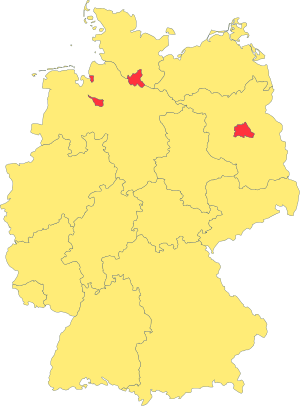


|
Foreign relations
Main article: Foreign relations of Germany

Germany hosted the G8 summit in Heiligendamm, 6–8 June 2007
The development policy of Germany is an independent area of foreign policy. It is formulated by the Federal Ministry for Economic Cooperation and Development and carried out by the implementing organisations. The German government sees development policy as a joint responsibility of the international community.[125] It was the world's third biggest aid donor in 2009 after the United States and France.[126][127]
In 1999, Chancellor Gerhard Schröder's government defined a new basis for German foreign policy by taking part in the NATO decisions surrounding the Kosovo War and by sending German troops into combat for the first time since 1945.[128] The governments of Germany and the United States are close political allies.[40] Cultural ties and economic interests have crafted a bond between the two countries resulting in Atlanticism.[129]
Military
Main article: Bundeswehr

The Eurofighter Typhoon is part of the Luftwaffe fleet
As of December 2015 the Bundeswehr employed roughly 178,000 service members, including 9,500 volunteers.[132] Reservists are available to the Armed Forces and participate in defence exercises and deployments abroad.[133] Since 2001 women may serve in all functions of service without restriction.[134] About 19,000 female soldiers are on active duty. According to SIPRI, Germany was the fourth largest exporter of major arms in the world in 2014.[135]

The role of the Bundeswehr is described in the Constitution of Germany as defensive only. But after a ruling of the Federal Constitutional Court in 1994 the term "defence" has been defined to not only include protection of the borders of Germany, but also crisis reaction and conflict prevention, or more broadly as guarding the security of Germany anywhere in the world. As of January 2015, the German military has about 2,370 troops stationed in foreign countries as part of international peacekeeping forces, including about 850 Bundeswehr troops in the NATO-led ISAF force in Afghanistan and Uzbekistan, 670 German soldiers in Kosovo, and 120 troops with UNIFIL in Lebanon.[137]
Until 2011, military service was compulsory for men at age 18, and conscripts served six-month tours of duty; conscientious objectors could instead opt for an equal length of Zivildienst (civilian service), or a six-year commitment to (voluntary) emergency services like a fire department or the Red Cross. In 2011 conscription was officially suspended and replaced with a voluntary service.[138][139]

No comments:
Post a Comment